I recently watched an A16z podcast featuring the founders of Mintlify, a documentation platform. Though Mintlify targets engineering documentation specifically, what struck me was how clearly it demonstrates what’s now possible with agentic AI that simply wasn’t conceivable before.
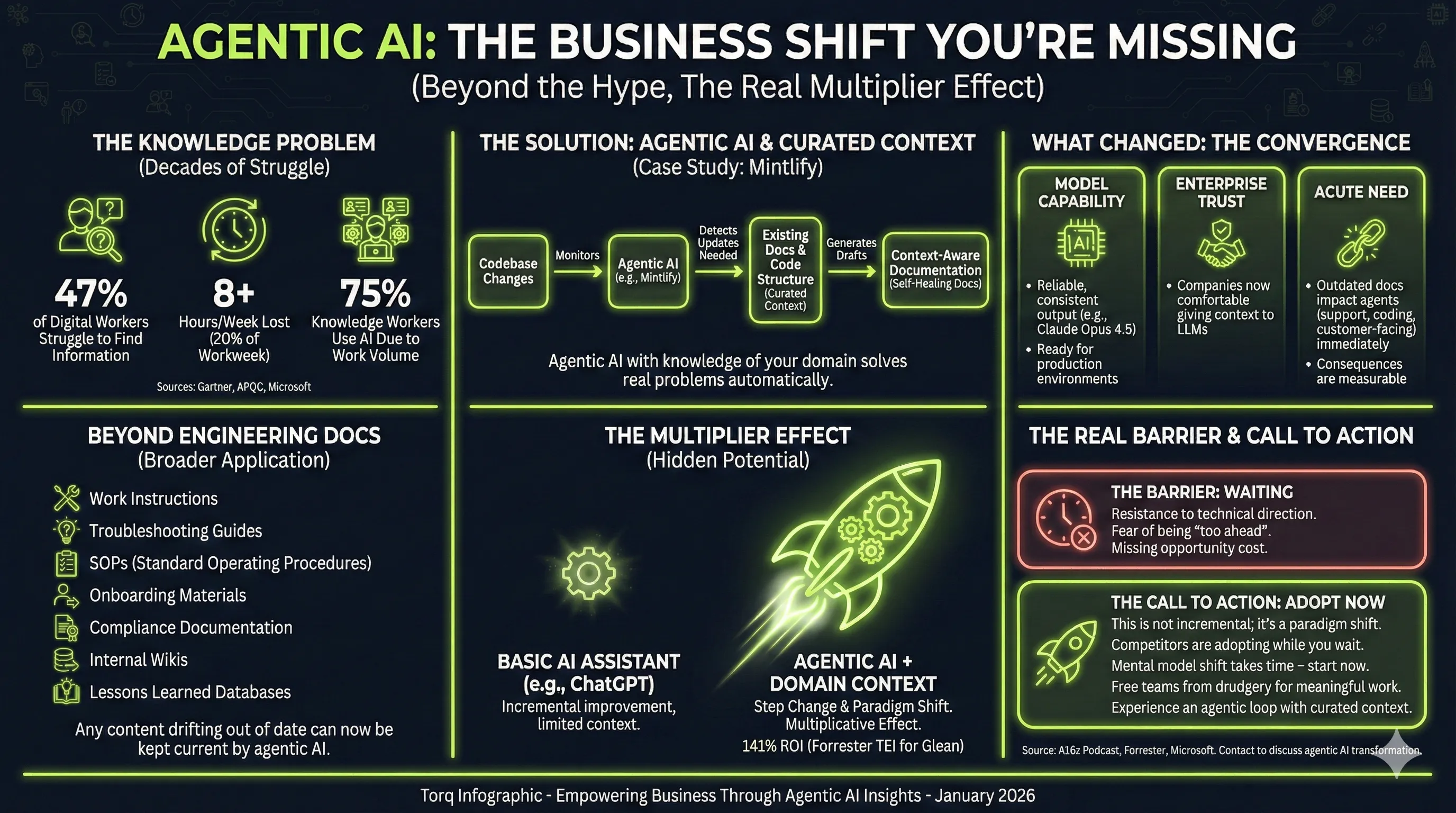
My interest isn’t in Mintlify as a startup story. It’s in their use of agentic loops. Their agent monitors your codebase, detects when code changes require documentation updates, and generates context-aware drafts using full knowledge of your existing docs and code structure. This is agentic AI with curated context solving a real problem, and it reveals the broader opportunity that most business decision makers are missing while they wait.
The Knowledge Problem Nobody Solved for 30 Years
Knowledge management emerged as a formal discipline in the early 1990s. Documentation staying out of date is a problem everyone has recognized since then. The research quantifies what we’ve all experienced.
- 47% of digital workers struggle to find the information needed to perform their jobs (Gartner 2023)
- Knowledge workers lose 8+ hours per week looking for, recreating, or duplicating information, roughly 20% of the workweek (APQC)
- 75% of knowledge workers now use AI at work, largely driven by being overwhelmed by work volume (Microsoft Work Trend Index 2024)
As Han from Mintlify points out in the podcast, the engineers who have the most context for how things work are neither incentivized nor paid to write documentation. They ship code and consider the job done. This organizational dynamic has persisted for decades.
What changed is that AI can now bridge this gap. Mintlify’s “self-healing docs” concept means documentation stays accurate automatically, without the manual labor that everyone avoided.
What Changed
Han specifically mentions that Claude Opus 4.5 was “a big unlock” for their self-healing docs feature. The model became reliable and consistent enough to actually maintain documentation in production environments. This is a shift from documentation being an application for humans to read, to documentation becoming infrastructure that powers AI agents.
Three factors converged to make this possible.
- Model capability reached the threshold for reliable, consistent output
- Enterprise trust shifted. Companies that wouldn’t give context to LLMs two years ago are now comfortable doing so
- The need became acute. When your support agents, coding agents, and customer-facing AI all depend on documentation as their source of truth, outdated content has immediate, measurable consequences
The podcast mentions that documentation has shifted from perhaps 50% for humans and 50% for AI agents, toward 10% for humans and 90% for AI by the end of this year. Not because fewer humans need documentation, but because the volume of AI agents consuming it is growing dramatically.
Beyond Engineering Docs
The Mintlify example is engineering documentation, but the underlying capability applies to any content that needs to stay current with changing business reality. Work instructions, troubleshooting guides, SOPs, onboarding materials, compliance documentation, internal wikis, and lessons learned databases.
The key insight is that anything drifting out of date because nobody has time to maintain it can now be kept current by agentic AI with proper context.
The Multiplier Effect Business Decision Makers Haven’t Seen
This is where I find it difficult to communicate successfully to business decision makers. Yes, AI models have improved. But the improvement people don’t see is what happens when an agentic harness with good context for a particular business domain is applied. That’s a level above raw model capability.
Software developers working in tools like Cursor AI and Claude Code have had this experience daily. The latest frontier models, given the right context and tools to dynamically retrieve more context, accomplish significantly more without hand-holding. The agentic framework makes the difference.
Business decision makers who have only used ChatGPT or basic AI assistants have no frame of reference for this multiplicative effect. They’ve set their opinion based on their last experience level with AI services. Combined with day-to-day operational pressures, getting deep into a subject holds no interest for them. Someone asking them to spend time understanding how much the technology has changed feels like an annoyance rather than a benefit.
Forrester’s Total Economic Impact study for Glean reported 141% ROI for AI-powered knowledge management platforms (TEI Report). The business case is concrete when the context and agentic framework are properly implemented.
The Real Barrier
One scenario I encounter repeatedly is that I present an opinion and guidance to go in a particular technical direction. There’s resistance. Then my technical opinion is proven correct. But regardless of repeated proof points, the response is often “you’re too ahead of the current time.” The preference is to wait.
Waiting is reasonable. You don’t want to be on the bleeding edge. But the corollary is that you’re missing opportunity cost that’s going begging right now. You could catch up later, but when the change is radical (a fundamental shift in how to think about work) the sooner you onboard the concepts, the better the result will be. There’s an inevitable delay in accepting radical changes because they require a mental model shift. That shift takes time.
I don’t want to sound like a crazy person saying “this is really important, you need to understand how much things will change.” But there’s a genuine possibility of a step change that could either fundamentally propel your business or fundamentally derail it depending on whether competitors adopt it first.
Don’t assume the understanding you built up from playing with AI three months ago applies now. You really need to experience an agentic loop with context that is curated well for your domain to see what can be achieved. It’s impressive.
The Step Change You Can’t Afford to Miss
This isn’t incremental improvement. It’s a paradigm shift in how work gets done. Your competitors could be adopting this while you wait. The mental model shift required takes time, and that time starts when you begin seriously engaging with the technology, not when you finally decide to deploy it.
The Mintlify podcast is worth watching. If you won’t take my word for what’s possible, look at what A16z is funding and what companies like Anthropic, Microsoft, and Coinbase are using. This is happening now, not in some theoretical future.
After decades in software development and automation, what excites me most is seeing people freed from drudgery. The tedious, repetitive work that drains energy and wastes talent. Agentic AI, properly applied, can eliminate entire categories of that grind. When I watch a well-designed agentic loop handle work that used to consume hours of someone’s day, I see people getting to focus on the parts of their jobs they actually enjoy and are good at.
I’d love to help businesses discover where agentic AI could transform their operations. Not as a technology exercise, but because seeing teams do more meaningful work with less friction is genuinely rewarding. If that resonates, contact me and we can talk through what’s possible together.
References
- Gartner Survey (2023) - https://www.gartner.com/en/newsroom/press-releases/2023-05-10-gartner-survey-reveals-47-percent-of-digital-workers-struggle-to-find-the-information-needed-to-effectively-perform-their-jobs
- APQC Knowledge Worker Productivity Research - https://www.apqc.org/blog/km-makes-knowledge-workers-more-productive-and-less-stressed-out
- Microsoft Work Trend Index 2024 - https://news.microsoft.com/annual-wti-2024/
- Forrester Total Economic Impact of Glean - https://tei.forrester.com/go/Glean/workAIplatform/
- A16z Podcast: Mintlify and the Transition From Human Docs to Agent Infrastructure - https://www.youtube.com/watch?v=tlxmmQ69cxE